POV Switch: Hamlet Act 1 Scene 1

(1.1 from Horatio’s Point of View)

Related image

Horatio:

I walk with my man, Marcellus, to the post we frequent on many a night for a bit of playful torture of the guards. For the past two nights, he has not ceased his talk of a spectral form, resembling the old king, that has been haunting the grounds. I have my doubts, as this seems to be a twisted tale of fantasy, but he assures me that all will become clear tonight if it composes itself again.

We sit with the soldier, Barnardo, talking of the spirit that may not be true, but is certainly intriguing. Suddenly, a short while after midnight, the phantom actually appears! I am astounded… And the form does certainly bear a remarkable likeness to the old King Hamlet, accompanied with full battle armor he had donned during the Norwegian wars.

I attempt communication with him, to hopefully find a cause for his reappearance, but to no avail. The ephemeral figure will not speak!

Why has he returned, then? What unfinished business must be completed?

I can only construct a semblance of an idea as to why the king has visited, and it has to do with turbulence surrounding those same Norwegian wars.

I recount my theory to the other equally dazed men, telling of how Hamlet had conquered and confiscated some of King Fortinbras’ land as a result of the war. As Old Fortinbras has grown weary, his son has stepped in, but he holds a drive for revenge. Young Fortinbras now plans to regain the lands his father had lost, which could have caused King Hamlet distress even in his final rest. The dead will often rise as an omen of something dastardly to come.

Again, the ghost appears but refuses any communication! It irritates me greatly… Instead, he stalks around until the cock crows, then hastily retreats with an emotion resembling fear. It is said in tales that it is common for the dead to avoid the day, as the night is when they are meant to roam.

Before taking my leave, I resolve to tell young Hamlet, my acquaintance and the Old King’s son, of our little incident and encourage him to attempt speech with the apparition. Maybe then, we will be provided with solid answers. 

Ain’t No Rest for the Wicked

Analysis of Hamlet’s sad boi lament in Act 1, Scene 2 (lines 133 to 164). 

O, that this too too solid flesh would melt
Thaw and resolve itself into a dew!
Or that the Everlasting had not fix’d
His canon ‘gainst self-slaughter! O God! God!
How weary, stale, flat and unprofitable,
Seem to me all the uses of this world!
Fie on’t! ah fie! ’tis an unweeded garden,
That grows to seed; things rank and gross in nature
Possess it merely. That it should come to this!
But two months dead: nay, not so much, not two:
So excellent a king; that was, to this,
Hyperion to a satyr; so loving to my mother
That he might not beteem the winds of heaven
Visit her face too roughly. Heaven and earth!
Must I remember? why, she would hang on him,
As if increase of appetite had grown
By what it fed on: and yet, within a month–
Let me not think on’t–Frailty, thy name is woman!–
A little month, or ere those shoes were old
With which she follow’d my poor father’s body,
Like Niobe, all tears:–why she, even she–
O, God! a beast, that wants discourse of reason,
Would have mourn’d longer–married with my uncle,
My father’s brother, but no more like my father
Than I to Hercules: within a month:
Ere yet the salt of most unrighteous tears
Had left the flushing in her galled eyes,
She married. O, most wicked speed, to post
With such dexterity to incestuous sheets!
It is not nor it cannot come to good:
But break, my heart; for I must hold my tongue.

Image result for broken crown

In Act 1, Scene 2, the newly betrothed King Claudius, who has taken over the throne from his late brother, and Queen Gertrude, mother of Hamlet, address their kingdom of Denmark. With the very recent passing of his father and the appearance of a falsified paternal figure, young Hamlet is wracked with grief. As he is heir to the throne, with a legacy to preserve, he is conflicted and frustrated when trying to conduct himself properly.

With the conglomerate of dreary developments that Hamlet must now confront, he becomes almost desperate to escape the situation. Pleading to the heavens, he wishes that the Lord was not opposed to “self-slaughter” (136) so that he may remove himself from the “stale, flat, and unprofitable…uses of this world” (137). He had already been brought to the deepest pits of his despair, and then his new step-father admonished him to simply ignore his mental turmoil, sending him into an even worse spiral.

Image result for hamlet emo

Hamlet is angered even more by the idea that someone like his father, who he most obviously idolized, could be replaced by such a second-rate character like Claudius. Hamlet saw his father as a glorious king who cared for both his kingdom and his wife with the same great care, yet both were eager to move on from him. Hamlet compares his world to an “unweeded garden that grows to seed” (139) where “things rank and gross in nature possess it merely” (140). People like Claudius are the weeds that dare to defile the Eden-like garden that his father had once cultivated, and Hamlet’s haven has become a place overrun with these devious serpents. Hamlet makes a few other comparisons between his father and Claudius, stating that it would be like comparing “Hyperion to a satyr” (144), or a god to a goat, or that it would be similar to comparing the greatness of Hercules to himself. In Hamlet’s eyes, his father was a godly king which his puny brother couldn’t dare measure up to.

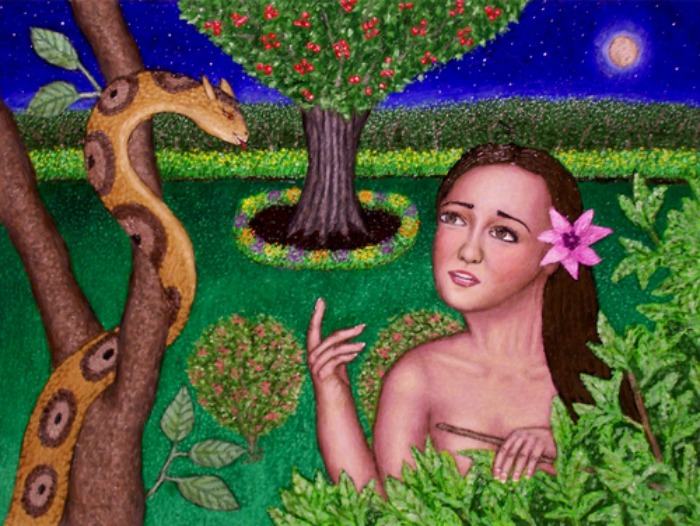
Image result for serpent in the garden

Not only was the late Hamlet a marvelous king, but he was a gracious husband who allowed no harm or discomfort to fall upon his Queen. They had been madly in love, and when he passed, the Queen was seemingly inconsolable like the Greek mistress “Niobe” (153). Yet, almost immediately after his death, Gertrude had willingly jumped into the “incestuous sheets” (162) of Claudius, tossing aside the sacred memory of the King. She acts as the alluded Eve who follows the deceptive path of the serpent, Claudius. While in that time it wasn’t seen as wrong or taboo to marry the brother of a late husband, Hamlet is so enraged by his mother’s actions that he perceives the situation to be something so disgusting as incest.

By the end of his indignant and somewhat childish diatribe, Hamlet is grief-stricken and hopeless. He wants nothing more than to be a catalyst for change, but he is also aware that he must conduct himself according to the public eye. He ends with his traumatic call, “But break, my heart, for I must hold my tongue” (164), as he agonizes be the loyal prince that follows in his father’s footsteps.

Failure and Redemption

Failure

Oh pretty bird how you are just like me,

With heart so pure and bones as light as sun.

Your path is one that’s destined to be free,

Instead, this cage has left your fate undone.


Why did the only thing that could free you,

Get lost among your valuables and change?

You sit and wonder what there is to do,

And why you cannot see beyond this range.


You had a few high hopes and dreams before.

The ones of princess charms and glitt’ring gold.

And now they’ve gone and hid outside a door,

They too are like the key that you have sold.


Oh pretty birdy you have gotten stuck,

And just like me, you see, you’re out of luck.


Redemption

I’ve come to find this love of mine

Has left me high and dry.

He ran off with the girl next door.

He thought he’d make me cry.


I guess her smile was more lovely.

I guess her eyes were clear.

I guess her hugs did bring him joy,

And so he kept her near.


He must’ve forgotten the time I spent

Devoted just to him.

Instead, he chose this new siren

Who loved him on a whim.


And last week when he said he was

Caught up in his work.

Came home close to twelve o’clock,

I almost went berserk.


I knew that he was with her for

Some conjugal contact.

Waltzed in the door without a care,

Expecting me to act.


To be a little housewife was

My only destiny,

And now that he has been untrue

I’m finally set free.


Little did he know that I was

Making some calls too.

Whenever he was off with her,

I was off with you.


Now, there are no strings attached.

He is dead and gone.

He was not my one true love, so

He’s buried in the lawn.


Why are you, Dorian Gray?

What’s in a face?

When crooked lines divulge your true passions.

Is that smile one of mischief or merry?

Your eyes speak flashes of cruel unusual hatred unbefitting of your beauty.

You must be a cruel master of men, then,

For the tricks your image plays leave no defense unbroken.

What have you done?

What treacherous acts mar those glorious brushstrokes?

Your crooked portrait sends shivers up the spine.

How could an angel so wrapped in glory become this creature of hell?

But, alas,

I think your majesty makes it all worth it.

To gaze upon such a glorious figure,

So young and fleshed in gold,

One could forget the men who go missing.

Because really,

How could those gentle hands and those promising words cause pain?

How could they cause pain other than the wish to have them praise you?

So, ignore the red flags.

This beautiful enigma makes us starve for the aesthetic.

Yearn for the passion.

Crave the fire.

We are in love.

So pray,

In the end,

That karma falls for you too.

Taking a Break

Clouded breaths on frosted walks

Sunshine keeps the Christmas clouds away

Days pass in a haze

Figures walk past with hushed voices

Hot cocoa

Too many hours spent cuddled under a blanket

The warmth keeps me content in my seclusion

I’m relaxed

Mornings become sacred

A time of peace

A time of quiet

I’m happy

Anticipation itches

Gifts are given

The holiday feels more real than it’s been

There are still tears

As we falsify a family for a few hours

I’m distant

I cling to my one life saver

But I’m still happy

It finally falls

Light twinkles against the dusty skies

The cycle works

Friends

Food

Midnight kisses in the back of strange comfortable cars

New friends

Old friends

People who are guilty for not missing you

But It’s a beautiful thing to reflect

Days of introspection become a necessity

You grow accustomed to the feeling

Yet all must good things come to an end

So I will see you again tomorrow

Literary Elements of Wuthering Heights


Motif: Nature is a strong motif utilized by Emily Bronte to analyze the effects of the nature vs. nurture theme within society. A strong comparison is continuously made between the main characters and different flora and fauna. The most prominent example occurs when Heathcliff takes possession of Hareton Earnshaw and he exclaims, “‘Now, my bonny lad, you are mine! And we’ll see if one tree won’t grow as crooked as another, with the same wind to twist it!”’”(155). Heathcliff, motivated by revenge on those who have scorned him, has made it his goal to make Hareton as uncultured and animalistic as he had once been. These two paragraphs are constantly spurned in the same way, as they act as doppelgangers for each other, and they are also both consistently compared to animals. Sometimes it is in a positive light, as they are compared to loyal companions or strong beasts, but most of the time it is a negative connotation meaning savage. Since they were both left to nature, instead of being nurtured, they had become animalistic “snakes” and “brutes”.
Archetypes: Heathcliff acts as one of the original examples of the Byronic hero archetype, which originated with Lord Byron and is described as “a man proud, moody, cynical, with defiance on his brow, and misery in his heart, a scorner of his kind, implacable in revenge, yet capable of deep and strong affection”. Heathcliff, as he was born a gypsy with a wildness to him, and since he only became a gentleman out of a desire for recognition and spite, holds an intense misery and drive for revenge in his heart. He turns against everyone in his high-class society at Wuthering Heights, stopping at almost nothing to acquire anything that has significant meaning to them, particularly their material goods. But, he holds a deep love for Catherine (first-generation) that is unstoppable even in death. He is haunted by her, destroyed by her death, and he is only satisfied again when reunited in death with her.
Diction/Syntax: An impressive use of diction utilized by Emily Bronte is the demonstration of intelligence through quotations. Characters that were established as high-class, such as the Lintons and Catherine, speak with a dignified language, using impressive vocabulary. The put an emphasis on being well-read, and illiteracy becomes a target for scrutiny throughout the book. Less educated characters, such as Joseph and Hareton, speak in broken quotations that the reader can barely make sense of. An example of Hareton’s intelligence is “‘It’s some damnable writing… I cannot read it”(181). He speaks like a brute and is illiterate, but he is not dumb, and he hates to be thought of as lesser just because he cannot speak as well. Heathcliff describes Hareton as “having first-rate qualities, and they are lost- rendered worse than unavailing”(180), which proves that Hareton could be just as good as the others if given the chance. Bronte uses her diction and syntax to comment on the emphasis placed on intelligence within society.

Twin Generations

Image result for wuthering heights family tree

Wuthering Heights is a novel in which Emily Bronte highlights the nature of duality between her twin juxtaposed generations she’s created. The first generation, composed of Edgar Linton, Heathcliff, and Catherine Earnshaw, is responsible for perpetuating certain qualities in the second generation (Linton, Cathy, and Hareton).

Each character of the first generation develops a counterpart within the second, allowing for fulfillment to finally be achieved after they have passed. Catherine, obviously resurrected in the form of Cathy, had been struggling with an eternal conflict. She could not choose which life she wanted to lead: whether to be with the wealthy and sophisticated Edgar or to be with the confident and brutish Heathcliff. She died feeling dissatisfaction with the choices she had made. She wished she could have instead lived as Catherine Heathcliff. As Cathy Linton was acted as this reincarnation, she ends up in the same predicament, kept suspended between two men (Linton Heathcliff and Hareton Earnshaw). She becomes Catherine Heathcliff but finds that Linton doesn’t actually represent her love. Ultimately, she finds herself in love with Hareton, who acts as the true counterpart of Heathcliff, and the cycle is broken as the two soulmates are finally united. Just as Catherine had always desired to be with her one true love.

It’s funny how the three names of Catherine end up portraying a related, but an entirely different cycle. The changes from Catherine Earnshaw to Catherine Linton to Catherine Heathcliff of the first generation, and then from Catherine Linton to Catherine Heathcliff to Catherine Earnshaw in the second, portray Cathy’s ultimate desire to reign as her own individual. Both Cathy’s were extremely strong-willed, the second-generation Cathy possibly even more so than her mother, and taking a man’s name at all had ultimately sullied their characters. But in the end, the Catherines were able to take back their original title of Earnshaw, and everything was how it should be. The twin-souls were united, and Cathy became her own person.


Sun People

Inspired by the beautiful people I had the pleasure of being around during Thanksgiving Break:


I think we should view people the way we view the sun.

I mean we’ve all heard the quotes from the movies:

“Her hair shined like the sun” “He was radiant as the sun”,

And on and on.

We call the sun beautiful, yet we never actually look at it for its conventional beauty,

But we can’t even look at the sun.

It’s just a flaming ball in the sky that hurts our eyes.

What we find truly beautiful is the way it makes us feel…

The feeling of its rays on a summer day

Sitting in the grass with your best friends, letting the light bathe your face

That is beauty.

We should look at people the same way;

Not blinded by appearances,

So the next time you’re with someone…

See them.

I mean really see them.

See the way their eyes shine like a thousand suns when they talk.

Feel the way your heart races,

Or that you just feel whole because they’re around.

Because people are gifts,

And it’s nice and all if they’re “pretty”,

But what really matters is how they make you feel…

POV Switch of Heathcliff the Hero

I walk in the grand front door, overhearing a commotion off in the kitchen. Cupboards slam, and I hear Hareton protesting, as Hindley parallels his son’s exclamations. This was a common occurrence in the Earnshaw estate, so I decide to head into the sitting room to think before the master can compose himself and bother me. I stretch out by the fire, resting my eyes, and fitfully contemplate Catherine. How I wish she would relinquish these fanciful ideals she has adopted from the Lintons. I miss my old wild accomplice…

Before I can get lost further in thought, my monologue is interrupted by a distinct pounding on the staircase followed by Nelly’s exasperated cries, an unfamiliar sound. I force myself upright and walk towards the cacophony in case intervention is necessary. A strange sight meets me as I lock gazes with Nelly, terrified and impassioned, and she motions for me to remain hidden. It was at this moment that I also notice the cause of the anxiety: Master Hindley dangling his son over the banister, most likely under the influence of drink and delusion. A confused look crosses his face as the boy slips from his grasp.

A split-second decision leads to the child landing safely in my arms, exhausted and crying softly. I had never taken much of a liking to him, but I held him close to alleviate his nerves. Everything stops in a few seconds of anticipation, then Hindley walks back downstairs utterly shaken. Nelly rushes to me desperately grabbing for her ward, releasing a few strangled cries. The master attempts to pass blame and grows angry again, ordering us to vacate, but I don’t stay for the end of his arguments. I saunter away, no longer capable of being in his detestable presence.

Masked


With silent tears and distant cries,
We hide our face behind these lies.
We laugh and cheer and make amends,
But does that really make us friends?

Our pseudonyms and aliases:
We thought we knew but never did.
Masks they come and masks they go,
Guises that we often borrow.

They speak in tongues that don’t belong,
To us an incoherent song.
Though messages are often said,
Their point falls flat and winds up dead.

The subtle stab of silken words
Betrays the things that go unheard,
“I’m fine” you say, but fine you’re not.
The world decides to pay no thought

To the pain you face,
Drowned in a bottle.
You play your ace,
Yet still you wobble.

And topple and tumble you will fall,
These masks we buy are owned by all.
If the truths you hide are not revealed,
Never will you be fully healed.